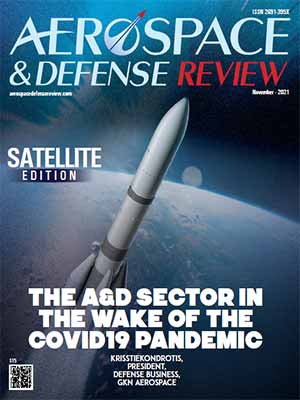
The A&D Sector in The Wake of the Covid19 Pandemic

Top 10 Satellite Solution Companies - 2021

With advancements in technology revamping satellite communications, satellite technology players are increasingly delivering sophisticated and advanced solutions to the aerospace and defense industry.

Machine learning models hold immense computing power that helps in critical decision-making related to spacecraft. When these trained models are transmitted to the spacecraft already in its orbit, the creation of any space debris can be prevented. Artificial intelligence is capable of analyzing data received from satellites and detecting problems to present deeper, actionable insights and facilitate informed decision-making.

The increasing demand for high-throughput data, voice and video links has led companies to introduce technical solutions that support satellite links. Recent developments in new waveform technology provide helicopters with unparalleled communication at high data rates. Advancements in the internet of things (IoT) space are also dramatically transforming the inflight Wi-Fi systems and satellite communications for enhanced flight experiences.

As such, the technological transitions in the arena open up a universe of new possibilities for satellite solution providers to develop and introduce innovative solutions. This implies that organizations looking for competent solutions have to choose from a plethora of options.

To make this task easier and assist leaders in identifying the right satellite solution providers, Aerospace and Defense Review presents to you, “Top 10 Satellite Solution Providers - 2021.”

A distinguished panel comprising CEOs, CIOs, VCs, Analysts, and the Aerospace and Defense Review editorial board has selected the top satellite solution providers. In our selection process, we looked at the company’s offerings, core competency, news/press releases, client testimonials, milestones, and other recognition.

    Top Satellite Solution Companies

  • Headquartered in California, Aitech is recognized as a leader in providing reliable, rugged embedded systems for the most unforgiving conditions in military, defense, aerospace, and space applications. The company has more than three decades of experience in fielding COTS or modified commercial-off-the-shelf products in subsystems to meet and exceed the requirements for several satellite missions with no failures reported. Aitech intentionally develops different grades or ruggedization levels of radiation-tolerant products, including its recent expansion with Series 300 products for LEO market, in addition to the Series 500 products for the GEO and deep space. At each level, the products come with radiation characterization and mitigation that is appropriate for the radiation environments at the price point that clients can afford

    aitechsystems.com

  • Providing innovative companies and Government and established Aerospace companies with a turnkey methodology to empower and accelerate their space-based initiatives

    astrodigital.com

  • California-based Orbotic Systems offers solutions that can transform the way the space industry performs space debris remediation, spacecraft propulsion, and develops newer, safer satellites. The company has collaborated with the University of Florida to license their D-3 technology (Drag De-orbit Device), which was developed at the academic institution in conjunction with NASA. The D-3 CubeSats that power Orbotic Systems’ space debris remediation can not only be leveraged to identify space debris but also be utilized as a tool to orbit and de-orbit smaller spacecraft at a fraction of the cost.

    orboticsystems.com

  • California based Ramon.Space has brought supercomputing into space and paved the way for affordable software utilization in the space industry. Ramon.Space aims to bring a dramatic change in the deployment of payloads and space systems by bringing more native computing to space. The firm has built a resilient computing infrastructure that provides earth-like computing capabilities in space under severe environmental conditions such as extreme temperatures. Ramon.Space has built computing systems around its internally designed processors, ICS machine learning, and AI DSP processors to allow the development of solutions in orbit

    ramon.space

  • Provides end-to-end SATCOM solution designs, engineering, test and evaluation, supply chain logistics, and technology life cycle management

    www.simbacom.net

  • Space Flight Laboratory (SFL) at UTIAS in Toronto specializes in building high-performance, low-cost small, micro-and nano-satellites. SFL supports the entire ‘Microspace’ development process, a highly focused, small-team approach to building spacecraft., SFL’s Microspace approach helps deliver superior satellites with quality assurance programs to align with clients’ needs. SFL leverages commercial-off-the-shelf technologies and heritage in-house technologies to complete projects at lower cost and in a timely manner without compromising on quality. All SFL satellites are built under a philosophy that emphasizes robust design and thorough testing.Since its establishment in 1998, SFL’s success has grown in leaps and bounds, making it a worldwide leader in low-cost yet effective Microspace missions

    www.utias-sfl.net

  • Datum Systems

    Datum Systems

    Datum Systems specializes in the manufacturing and suppyling of various telecommunication systems for various commercial applications

  • Get SAT

    Get SAT

    Get SAT, is the leading provider of micronized satellite on-the-move terminals for ground, air and maritime applications

  • Kythera Space Solutions

    Kythera Space Solutions

    Kythera Space Solutions is the leading provider of dynamic management systems for next-generation satellite payloads and SATCOM networks

  • Mu-Del Electronics

    Mu-Del Electronics

    Mu-Del Electronics design, develop and manufacture high quality RF & Microwave products

Satellite Solutions FAQ

Q1
What Do Top Satellite Solutions Providers Do?
Top Satellite Solutions Providers design, integrate and support satellite-based services that help organizations connect, monitor, navigate and analyze activity across remote or distributed environments. Their work can include satellite communications, Earth observation, geospatial intelligence, IoT connectivity, payload integration, ground systems and data platforms. Strong providers translate complex space infrastructure into practical services for enterprises, governments, telecom operators, defense users, logistics networks, energy companies and environmental organizations that need reliable coverage beyond the limits of terrestrial networks.
Q2
Why Do Top Satellite Solutions Providers Matter Now?
Top Satellite Solutions Providers matter because satellite technology is becoming more accessible, data-rich and closely tied to everyday decision-making. Demand is rising for resilient connectivity, faster disaster response, climate monitoring, border awareness, maritime tracking and remote asset management. Low Earth orbit networks, smaller satellites and improved analytics are widening the use of satellite solutions beyond traditional aerospace users. For many organizations, satellite capability is no longer a distant technical layer; it is part of continuity planning, intelligence gathering and digital infrastructure.
Q3
How Are Leading Satellite Solution Providers Typically Evaluated?
Leading satellite solution providers are usually assessed by the reliability of their networks, depth of technical expertise, coverage capability, data quality, integration experience and ability to support mission-specific needs. Evaluation also considers security standards, regulatory awareness, uptime, latency, interoperability and customer support. For a Top 10 editorial list, the focus is not only on scale but also on how effectively a provider turns satellite technology into usable value for different sectors, from enterprise connectivity to Earth observation solutions and critical communications.
Q4
What Value Do Satellite Solutions Create for Organizations?
Satellite solutions help organizations operate where fiber, cellular or traditional infrastructure may be unavailable, damaged or too costly to deploy. They support real-time visibility across ships, aircraft, vehicles, remote facilities and environmental zones. Enterprises can improve continuity, governments can strengthen situational awareness and communities can gain connectivity in underserved areas. Top Satellite Solutions Providers also help convert satellite data into insight, supporting better planning, risk management and resource allocation across industries that depend on location, timing and reliable communications.
Q5
What Role Do Innovation and Technology Play in Satellite Solutions?
Innovation shapes the performance, cost and reach of modern satellite services. Advances in small satellites, reusable launch models, software-defined payloads, AI-assisted analytics and cloud-based geospatial platforms are changing how satellite technology providers deliver value. Automation can speed image processing, anomaly detection and network management, while stronger ground infrastructure improves usability. The best providers combine space systems, data engineering and service design so organizations can adopt satellite capabilities without needing deep in-house aerospace expertise.
Q6
What Should Decision-Makers Prioritize When Comparing Satellite Solutions Providers?
Decision-makers should look beyond coverage maps and compare how well each provider fits the intended mission, budget, security needs and operating environment. Important factors include reliability, service-level commitments, regulatory compliance, integration support, scalability, data ownership and long-term technical roadmap. It is also useful to assess whether a provider offers communications, analytics, infrastructure support or a full-service model. Top Satellite Solutions Providers stand out when they combine proven satellite capability with clear implementation guidance, responsive support and measurable value for the organization.